
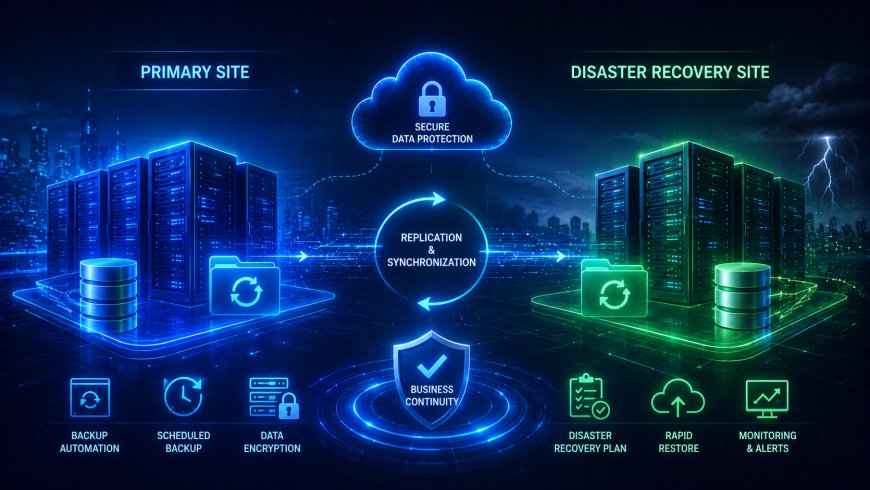
1. Data Loss and Ransomware Threats in the Digital Age
In a world where data is the most valuable asset, business continuity faces unprecedented threats. From hardware failure and natural disasters to human error and targeted ransomware attacks, any single point of failure can paralyze your operations. Traditional local tape backups are slow to recover and vulnerable if the primary data center is compromised. Modern businesses require millisecond-level recovery capabilities.
2. Core Architecture and RPO/RTO Metrics
Modern Disaster Recovery (DR) solutions move away from passive local backups to active, multi-layer cloud architectures. We design solutions based on two core metrics: Recovery Point Objective (RPO - how much data loss is tolerable) and Recovery Time Objective (RTO - how fast the system must be back online).
- Cold Backup: Periodic synchronization to cloud deep storage at minimal cost, suitable for archives with flexible RTO requirements.
- Warm Standby (Pilot Light): Maintaining a minimal core infrastructure in the cloud that can quickly scale out to handle traffic within minutes in case of disaster.
- Hot Standby (Multi-Site Active-Active): Designed for zero-tolerance services like finance. Synchronous clusters in different regions provide instant DNS switching and zero downtime if one site fails.
3. Multicloud Offsite Backup and Cold Storage Layout
We leverage the global infrastructure of major clouds to build indestructible defenses:
- AWS Elastic Disaster Recovery (DRS): Real-time block-level replication of physical or virtual machines to AWS, enabling recovery in minutes on EC2 instances.
- Google Cloud Backup and DR: Seamless integration with Google storage snapshots, ideal for archiving unstructured data at ultra-low cost.
- Azure Site Recovery (ASR): Deep integration with Windows and SQL Server for cost-effective cross-region failover.
4. Disaster Recovery Drills and Continuity Advisory Value
Building a DR architecture is just the start; the real test is a successful switch. Wang Cloud helps establish Business Continuity Plans (BCP). We use Infrastructure as Code (IaC) to perform regular "automated non-disruptive DR drills" to verify backups and routing. We also implement WORM (Object Lock) mechanisms so that even if a hacker gains admin access, your life-saving backups cannot be deleted or encrypted.